Six digital collections of documents, photographs and artifacts from the Medical College of Wisconsin can now be discovered through Recollection Wisconsin. The collections, created by the MCW Libraries, trace the development and consolidation of Wisconsin’s first medical schools beginning in the 1890s. Read more about the collections here.
Additional digital projects in the works from the MCW Libraries include an oral history collection highlighting the experiences of faculty members and a timeline covering the history of the College from the founding of the Wisconsin College of Physicians and Surgeons in 1893 to the establishment of the MCW-Green Bay campus in 2015.
WiLS is excited to announce that Roy Tennant from OCLC Research will be presenting the keynote address for Peer Council 2015!
Roy Tennant is a Senior Program Officer for OCLC Research, where he manages projects relating to technology, infrastructure, and standards. Previous employers include the California Digital Library and the University of California, Berkeley. Read more
Our partner organization CESA 2 Purchasing, has negotiated great prices for purchasing as well as a buyback program for textbooks for WI. Please see: Textbook Warehouse for detailed information.
For questions please contact James Adams at Textbook Warehouse directly. His contact info is 800-796-9152 x224 or
Capstone is releasing new database to be added to the popular PebbleGo! suite. Coming August 2015, PebbleGo! Dinosaurs will be available. For more information on the content and availability please see: PebbleGo-Dinosaurs-PreSale-Flyer.pdf
Join us in Madison at the Pyle Center on Monday, June 8th for Peer Council! Peer Council is an annual assembly of those involved with and interested in library technical services to learn about new developments and connect with colleagues. Read more
WiLS vendor partner Columbia University Press is working with Academic Rights Press to bring EntertainmentID to North America. Entertainment Industry Data is a library of Media Statistics bringing you all the professional numbers behind the industry. Entertainment ID brings together Film ID and Music ID in a single platform. For more information or for pricing and trial requests, contact Jeff Brunner ().
One of our greatest joys at WiLS is hearing our members tell the stories of the big and important work they are doing – interesting new projects or initiatives, or even interesting and new approaches to old projects. And, in addition to hearing about it, it makes us even happier when we can share those stories with other members. Each month, WiLS is proud to feature an interview with one of our library members. This month, we interview Lisa Viezbicke, Director of Library and Archives at Beloit College and WiLS Board Member.
This interview is part of a series of interviews with both WiLS library and vendor partners. Your feedback is appreciated. If you have any to offer on this article, or suggestions for upcoming interviews, contact Andrea Coffin at .
Why did you, personally, choose to work in libraries?
It has been a lifelong commitment – I volunteered in my grade school learning center and worked in various departments at the public library in high school and college. My college work-study position assisted the reference librarians and library director with preparation and evaluation of the library research skills instruction and assignments. I’d been mentored by librarians my entire life but it wasn’t until I returned to my local public library to add part-time copy cataloging work to my already busy full-time work schedule that their hints came together to suggest a path. In the quiet, after-hours of the TS workroom I realized how much satisfaction I received from facilitating learning, enrichment, serendipity, and information need fulfillment.
What is unique about the culture of your library? How do you influence it?
Many people retire from Beloit College Library – we have a long tradition of library directors, librarians and staff finding their ‘forever home’ here. The community within and beyond the library and the commitment to student development from all corners of campus lend an interesting mix of comfort and energy. That, combined with the continuous evolution (natural and engineered) of our work, work roles and opportunities it sometimes feels like you have a new job every four or five years.
The community within and beyond the library and the commitment to student development from all corners of campus lend an interesting mix of comfort and energy.
What do you think is important to know about the patrons or community you work with? What helps you understand those needs?
Beloit students and faculty embody the language of the college’s mission statement – intelligence, curiosity, high achievement, personal responsibility and public contribution. As a residential college, we are part of the community. We know and support our faculty, students, and fellow staff members. Our library team is visible, approachable, and questioning. They attend student and faculty symposium presentations, work side-by-side with students in daily operations, and consult on and support projects and research, co-host events in the student run-bar
What big ideas are being worked on at your library? What problems are being solved?
We are actively working to capture, organize and preserve the born-digital components of the College’s culture and operations. A new digital archivist position and pilot repository have been established to ensure continuity of the institutional record as we find less and less physical documentation and communication in our daily operations. On another front, librarians and archivists, collaborating with our IT peers, are consulting on and supporting faculty-driven digital humanities projects. Our teams are engaging and exposing unique elements of our collections as they develop new skills and contribute to evolving forms of scholarship. Finally, with the recent release of the new ACRL Framework for Information Literacy we are beginning a project to help faculty realize and assess information literacy outcomes in the context of campus developmental and learning objectives.
The town hall is exclusively for Reprints Desk academic customers and designed to provide you and other customers with an additional forum for asking questions, getting answers, and sharing what’s on your mind.
This isn’t a disguised sales pitch or a replacement for private account-related discussions. Rather they are intended to provide you with yet another avenue for engaging with us and exploring what’s possible for external document delivery at your institution.
Reprints Desk hopes you will join this town hall event and that you will share a question or two about what you are interested in learning or hearing during this meeting.
At WiLS, we want to bring valuable information to our library partners, including information about the missions and big ideas of the vendors they may already do business with. Each month, WiLS will interview a vendor partner in order to bridge the gap and open the door to valuable collaborations. This month, we are delighted to share insights from Susan Gall, co-owner (with her husband, Tim Gall) of Lincoln Library Press, Inc.
These interviews are part of a series of interviews with both WiLS library and vendor partners. Your feedback is appreciated. If you have any to offer on this article, or suggestions for upcoming interviews, contact Andrea Coffin at .
Tell us about your company’s background.
Our company was originally named Eastword Publications Development. When my business partner (and husband) and I launched our business in 1992, we were book producers. Publishers hired us to develop titles. We were a turnkey operation, taking a project from an initial idea all the way through to finished pages for the printer and SGML files for online publication. We specialized in multivolume sets for libraries. We developed several dozen titles for Gale Research, now Cengage. We worked on Gale and UXL versions of the Worldmark and Jr. Worldmark Encyclopedia of the Nations, The Gale Encyclopedia of Psychology, Cities of the World, Notable Asian Americans, Women’s Firsts, Chronology of Women’s History, and many more.
In 1998 we decided to become a publisher and to produce our own titles. We began by acquiring the rights to publish the Lincoln Library titles, including the acclaimed multivolume Lincoln Library of Sports Champions and Lincoln Library of Essential Information, a single-volume encyclopedia first published in 1924. We published new editions of both titles and expanded the Lincoln Library line with a seven volume set, Lincoln Library ofShapers of Society, and a five-volume set on Greek & Roman Mythology–which won the Benjamin Franklin Award for excellence in editorial and book design. With the success of those titles we changed the name of our company to Lincoln Library.
In 2009, we launched FactCite: Lincoln Library Online – as an enhancement to Lincoln Library print titles. However, the site took on a life of its own. In 2013, Library Media Connection/ARBA named FactCite “Best Overall Reference K-12” in their Best in Reference Awards. Subscriptions were growing exponentially, and in 2014, we made the decision to stop publishing books and to focus on FactCite.
Why do you, personally, choose to work with libraries?
We have been in love with libraries our entire lives. My business partner has particularly fond memories of one of his first jobs–as a page at the main branch of the Cleveland Public Library. At one point or another he shelved books in every department, learning to “read the stacks” and stumbling across all sorts of great books. (He likes to tell the story about the time the pages spiked the punch at a staff party, and then hid the empty bottle in a part of the stacks they knew was infrequently visited.) The main branch of Cleveland Public Library was, and continues to be, a magical place.
Librarians are inspiring for their intellectual curiosity and for their fierce defense of every student’s right to learn.
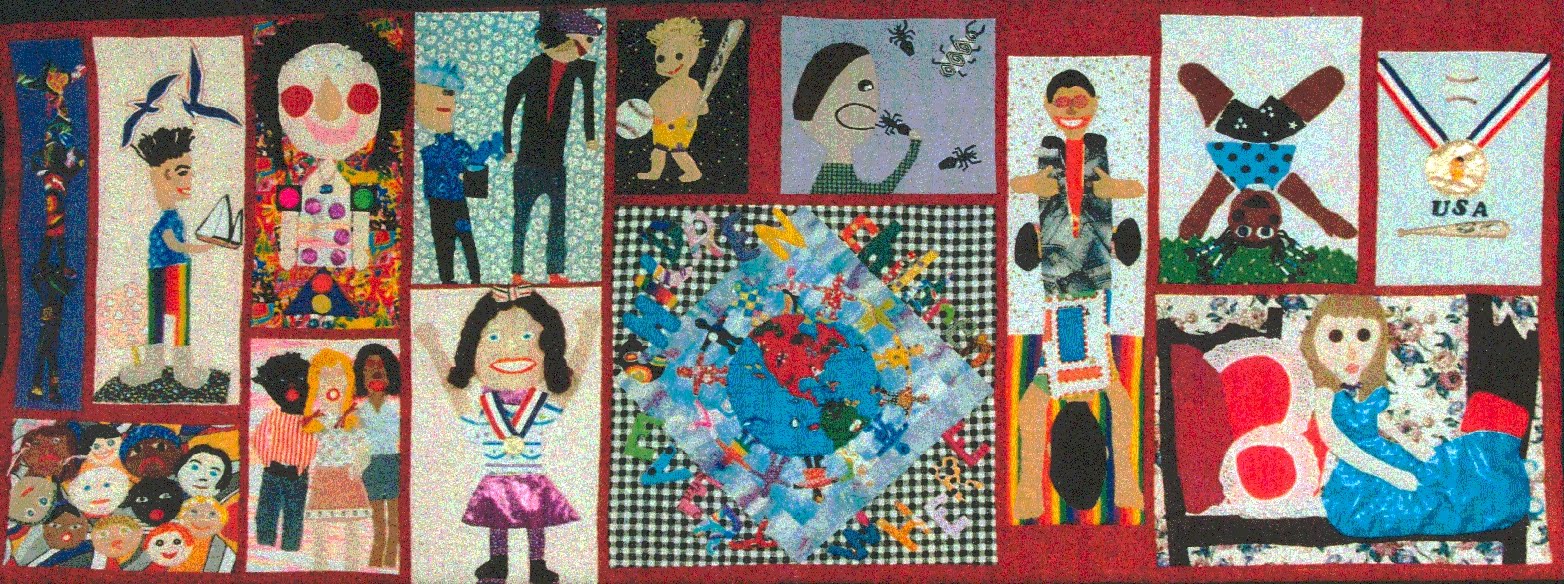
I share his enthusiasm for libraries. I am a longtime member and former president of the Friends of the Shaker Library in the community where we live. One memorable accomplishment during my tenure was a multigenerational quilting project. Adult quilters and children worked together to create a quilted wall hanging inspired by Jack Prelutsky’s poem, “Children, Children Everywhere.” The quilt adorns the soffit of the children’s room in the branch library – and a framed letter from Jack Prelutsky celebrating the project hangs nearby.
A librarian who knows the best books to read and who can direct someone to the best sources of information is invaluable. Librarians are inspiring for their intellectual curiosity and for their fierce defense of every student’s right to learn. (Our daughter Lizzie is head of youth services at the Grand Rapids Public Library in Michigan. Need I say more?)
What do you like to know about the libraries you work with? What helps you better understand their needs?
We like to think of our customers (students, teachers, and librarians) as our partners. We work hard to get to know them and to learn what they need. We ask what students are studying and how we can do a better job of providing them with appropriate and challenging material.
To make it easy for our subscribers to provide input, we have built-in ways for students to send us feedback. At the end of every FactCite article is a link that enables readers to tell us what they think. We love the feedback, even when it is a little off topic, like the one below:
<> = to HAHAHAHA!!!!
While the comments come to us anonymously, we do know which school or public library sent the comment. This helps us address the needs of students who are struggling or can’t find what they are looking for. We can contact the librarian in an effort to help. For example, a user may send a comment such as “this should be longer” or “what happened next?” If we agree, we will expand the article. Our editors love responding to student comments, and sometimes we post expanded articles within a day.
Our librarian customers tell us that it is empowering for students when the librarian is able to show them that their input helped improve FactCite. We are all in a community of learning and we like to think that our role can make a difference. What we really cherish are comments like the following:
awesome !
What big ideas are being worked on at your company? What problems are being solved?
We are constantly looking for ways to improve FactCite. In addition to our Lincoln Library content, we’ve partnered with two other publishers to bring online editions of their print products under the FactCite umbrella. For younger researchers, we’ve added Biography for Beginners, which was a popular print product for elementary schools until 2012 and is now a popular resource on FactCite. In November 2014, we launched Defining Moments in U.S. History Online, based on the 30-volume (and growing) print series from Omnigraphics. The addition of Defining Moments substantially increased our content on American History for students in middle and high schools.
Subscribers asked us for audio read along, so we added that feature. It helps younger readers and ESL/ELL students with the text. We have improved the page design to reduce scrolling. We are committed to keeping FactCite accessible for all researchers, so our screens are distraction-free. As one librarian wrote, “students like that FactCite is easy to read and uncluttered, yet still includes photos and other graphics.”
For next school year, we’ll be introducing some new features that will make FactCite even more fun for student researchers.
How can librarians become partners in product or training development?
Our “send a comment” feature at the end of every FactCite article makes it easy for subscribers to function as our partners. Librarians regularly send us suggestions, such as lists of biographies or the outline of a country report assignment, so that we can consider adding profiles or country facts not currently included in FactCite.
Do you have anything else you’d like to share?
We exhibited for the first time at WEMTA this year – and enjoyed meeting our customers and prospective customers. We have subscribers from Appleton to Rhinelander, from Eau Claire to Tomahawk, from Clayton to Winneconne. FactCite databases are affordable and accessible to students of all reading levels. FactCite displays well on Chromebooks, smartphones, tablets, and Internet-enabled e-readers, and is a low bandwidth resource that works well when an entire class is online simultaneously. And we do not have voicemail – when you call (800) 516-2656 you will always reach a person!
When Madison Metropolitan School District added OverDrive’s School Download Library, they were faced with a familiar challenge for school districts: how do you efficiently and effectively train 46 media specialists on the new service? Enter LibGuides! Read MMSD’s Cathy Daane’s article about this experience.
Subscribe to WiLS Communications to receive This Week at WiLS, WiLS Community Chronicle, or email correspondence related to ILL, technology, cooperative purchasing, and technical services.